I have a 6 month old. Here’s how I’m thinking about the measles outbreak.


Like many parents, I watched the news this week that the US has lost its measles elimination status, and I’ve been trying to figure out what to do to protect my son (who just turned 6-months-old!) He’s now eligible for an early dose of the MMR vaccine, and I’ve been debating whether or not to give it to him. I’ve been seeing this trending on social media too, with many parents wanting to give their children the shot and wondering if it’s the right decision.
I decided to do a deep dive into the data. Here’s what I found.

Measles is back, and the tiniest among us are vulnerable
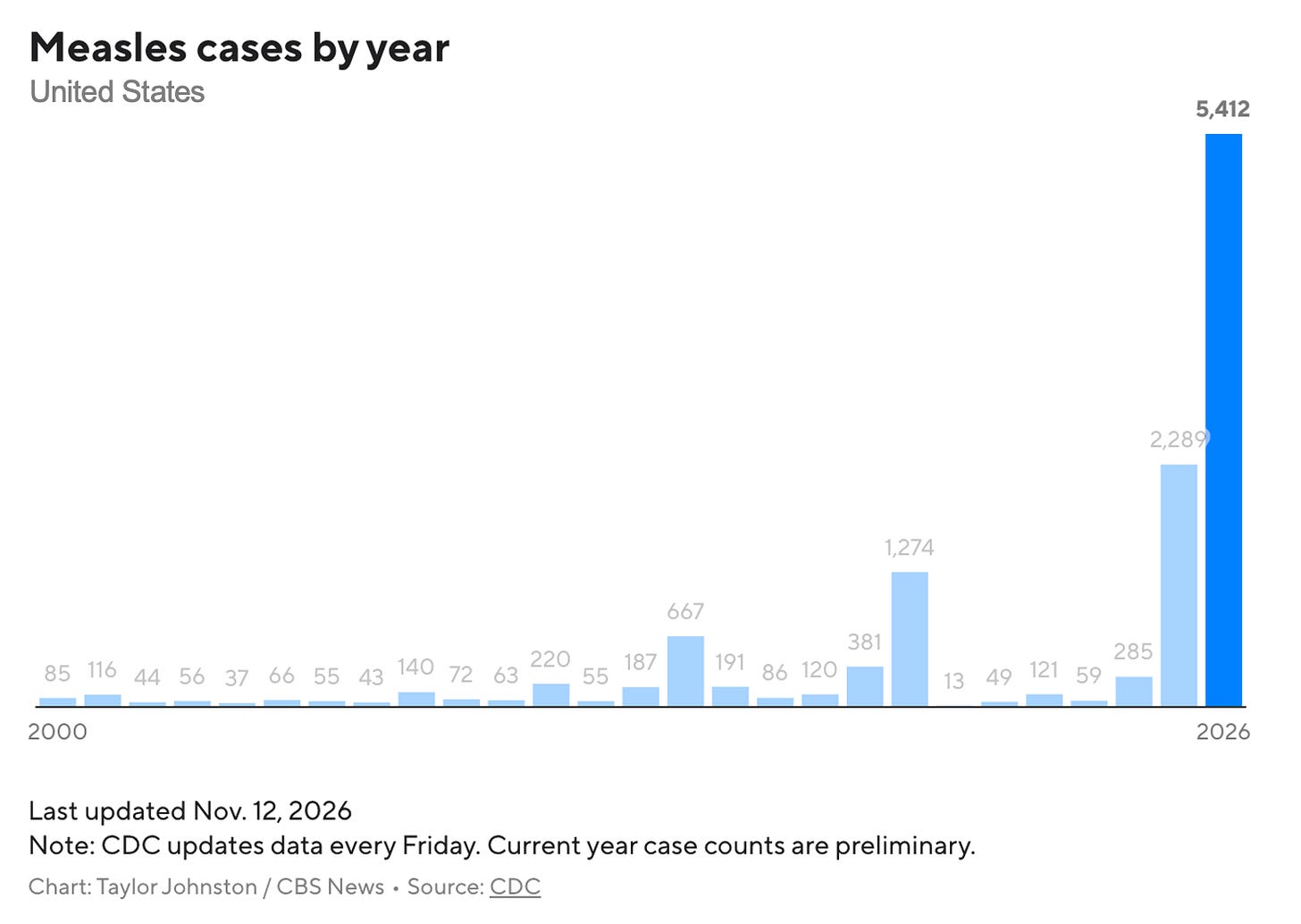
Up until this year, measles had been eliminated from the US since 2000, meaning we only had sporadic cases, most often imported from US travelers who caught the virus abroad and brought it home. For over two decades, high levels of immunization across America helped prevent those sporadic cases from becoming outbreaks, protecting little ones like my son who currently doesn’t have immunity against measles.
But over the last two years, things have changed. Due to dropping immunization rates leading to numerous outbreaks, measles has achieved sustained transmission within the US for a full year. That means many cases are now homegrown, and measles is officially endemic again. So far in 2026, we’ve had over 5,400 cases and 10 deaths, far more than any year over the last two and a half decades. On Tuesday it became official: the US has lost its measles elimination status.
What’s a parent to do?
My son is currently in a tricky period when it comes to measles: he’s in a window of vulnerability where he likely doesn’t have protection against the virus. During his first few months of life, he had some of my protective antibodies that I passed to him during pregnancy, but studies have shown those antibodies drop below protective levels in many babies within the first few months, and by 6 months, most babies no longer have enough to protect them (even with breastfeeding). And he isn’t due for his first dose of the measles, mumps, and rubella (MMR) vaccine until he’s 12 months old.
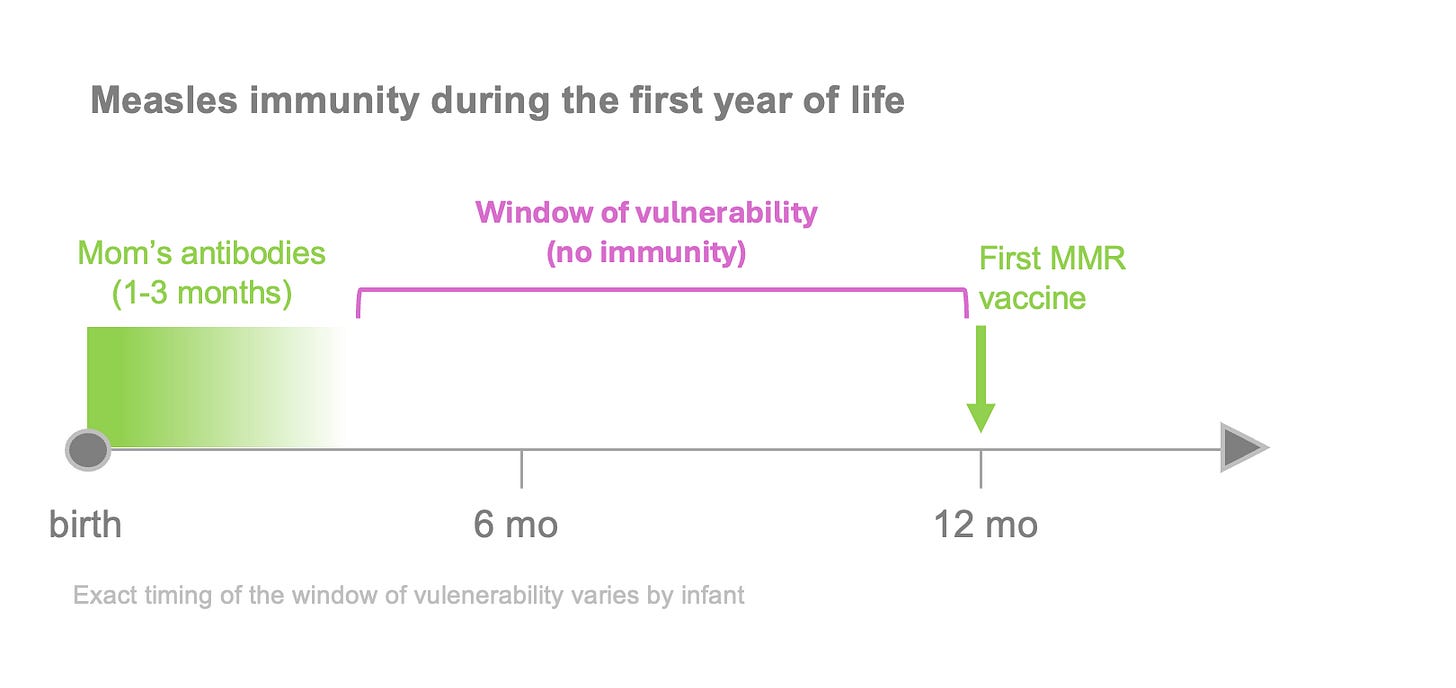
Back when measles was eliminated, this vulnerable period didn’t matter so much. When a community (or country) has above a 95% vaccination rate, measles can’t sustain spread, protecting the littlest ones during their window of vulnerability.
But now that measles is back, this period presents a real risk. So, what’s a parent to do?
For some infants, it may makes sense to get an early dose of the MMR vaccine
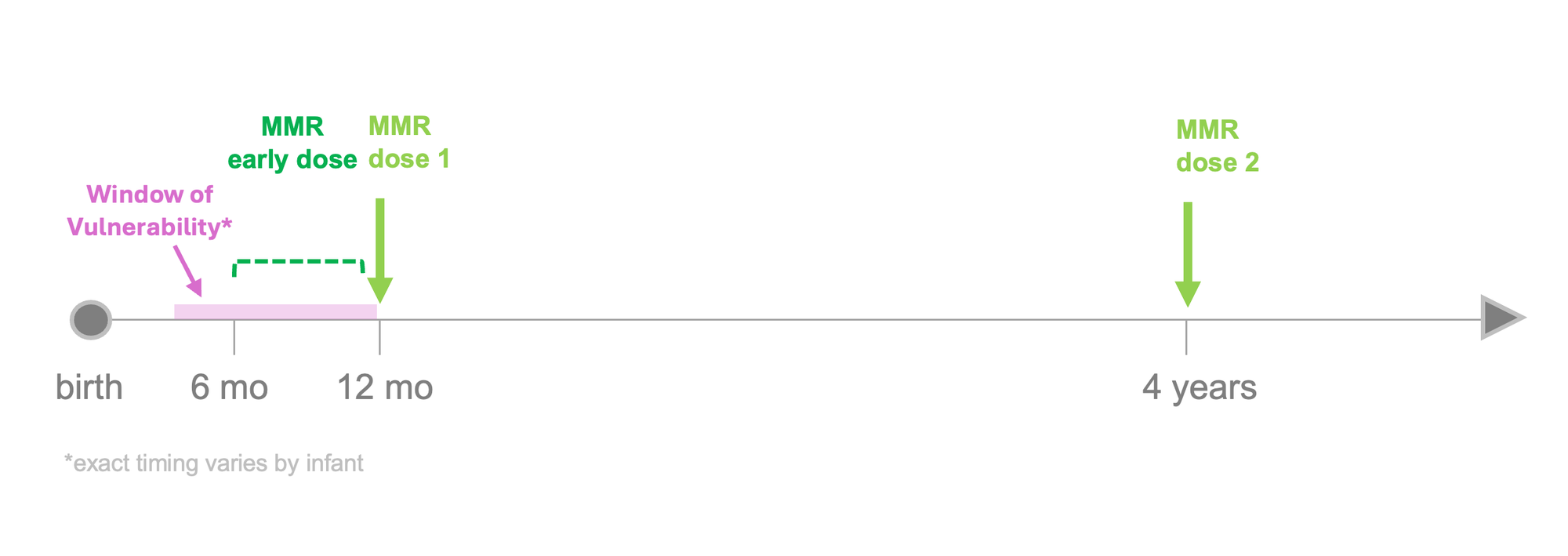
The standard US schedule for the MMR vaccine includes two shots: one at 12 months and the second at 4-6 years. This two dose series provides strong protection (93% effective after the first dose, 97% effective after both).
But, the MMR vaccine may be given to infants starting at 6 months, and for some infants, it makes sense for them to get an extra dose early. (In scientific circles this early dose is called ‘zero dose,’ though personally I think that’s a confusing name for public communication, so I’m calling it an ‘early dose.’)
Who should get an early dose?
Currently, the guidance from the CDC and American Academy of Pediatrics (AAP) recommends an early MMR dose at 6-11 months for the following tiny humans:
- infants who are traveling internationally (at least 2 weeks before travel)
- infants who live in an area with an outbreak
- infants traveling to an area with an outbreak
This means if you are in one of the US communities with an active measles outbreak and have a 6-11 month old infant, an early dose is recommended.
But this guidance still leaves a lot of gray area, and is in some ways conflicting. The international travel recommendation is in part based on the fact measles is endemic in many parts of the world — now that it’s endemic in the US, what does that mean? What counts as “near an outbreak?” (right now this is largely left up to local health departments). I’m hoping for more detailed guidance from the AAP on who should get this early dose, but for now, this is what we’ve got.
How do I know if my community is having an outbreak?
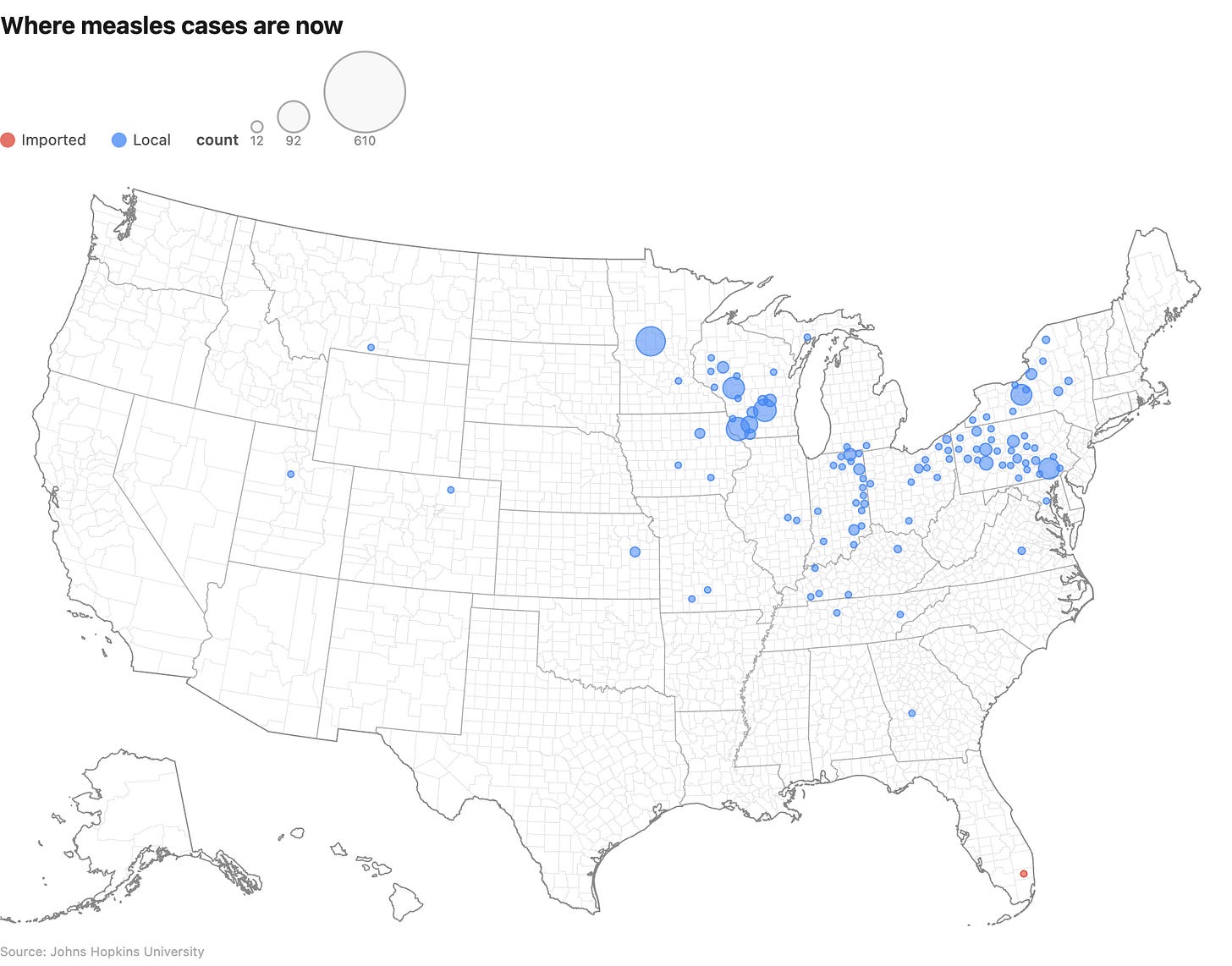
Your health department’s website is the best place to check for the latest details specific to your area. Johns Hopkins has also created a very nice measles tracker that shows where local outbreaks are happening as well as local vaccination rates for the MMR vaccine.
How well does the early dose work?
The early dose provides significant but not as strong of protection as the standard two dose MMR vaccine series, and infants who get an early dose will still need their 12-month and 4-year MMR shots (the early dose is extra). When given before 9 months, the early dose is about 58% effective and when given between 9 and 11 months, it’s 83% effective. The older a baby is, the better the immune response to the vaccine. Studies have shown there is not an increase risk of adverse events for an early dose (one study found side effects were actually lower).
Why don’t we just give the early dose to everyone?
There are reasons an early dose is not automatically recommended for every 6 month old, and instead recommended for those who are at higher risk of exposure.
Reason #1: It doesn’t produce as strong or reliable a response, so it doesn’t count toward the MMR series. Because a 6-month-old’s immune system is still maturing, the early dose doesn’t trigger as strong of an immune response as a dose at 12 months. This is why infants who get an early dose still need the standard two dose MMR series. For infants who at higher risk of catching measles between 6 and 11 months (those near an outbreak), it makes sense. For everyone else, it doesn’t.
Reason #2: An early dose might affect how well the immune system responds to measles vaccination later in life. This is where the data gets mixed, and we don’t have as conclusive of an answer as we would like. Several studies have found that infants who receive an early dose (especially before 9 months) have lower measles antibody levels after the standard vaccine series compared to kids who didn’t get an early dose. A study of 123 children in the Netherlands looked at long-term measles antibody levels, and found that those who received an early dose before 9 months had significantly lower measles antibody levels at age 6 (blue dots in the graph below), even though they had received the first standard measles dose as well (which in the Netherlands is given at 14 months, second dose occurs later at age 9):
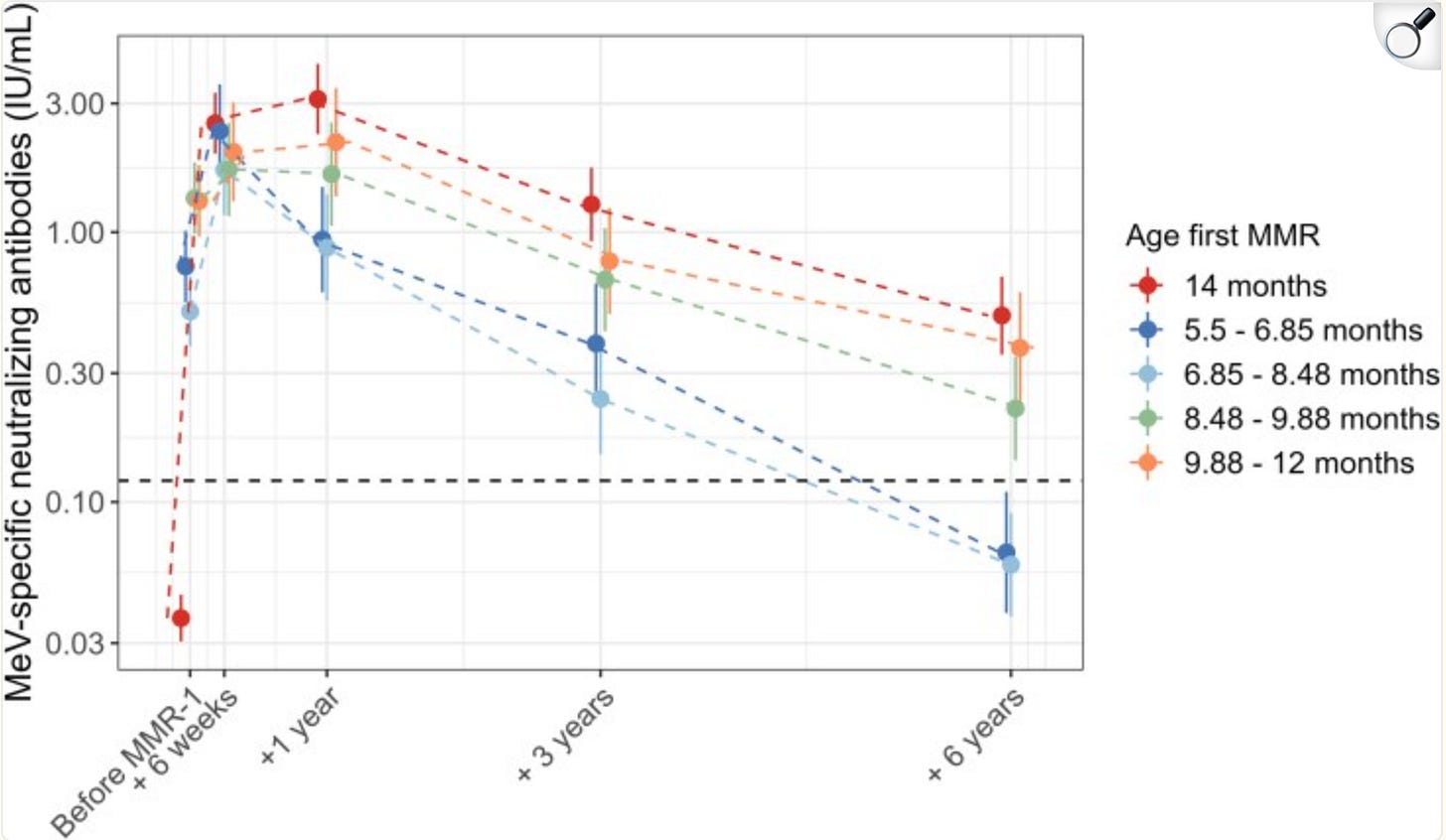
These data have led to the concern that giving an early dose (especially before 9 months) could blunt long-term protection against measles. BUT, the data are inconclusive, and there are some big caveats: antibody levels don’t correlate perfectly with actual protection against measles, studies of vaccine effectiveness after an early dose still show high protection, the Netherlands has different timing for the MMR vaccine compared to the US (so it’s not directly comparable), other measures of immunity (T cell response) are maintained long-term even with an early dose, and the vast majority of these studies don’t look at clinical outcomes (whether children actually caught measles), which is the outcome that ultimately matters.
My read of the data: this is a possible risk, but not a sure thing. Still, it should be taken into consideration, and is one of the reasons we don’t throw an early dose at every 6 month old. If they are in an active outbreak area, an early dose certainly makes sense. But if a child is at low risk of encountering measles before their first birthday, it makes sense to wait.
What happens if a baby is exposed to measles before getting vaccinated?
If a baby (or unvaccinated adult) is exposed to measles and is eligible for the MMR vaccine, there’s still time to get the shot — they can get it within 3 days of exposure and it will provide some protection. For people who can’t get the MMR vaccine as well as certain high risk groups (including babies up to 12 months), there is an antibody treatment that can be given within 6 days of exposure. Call your pediatrician right away if your baby was exposed, and they will guide you through the process.
So, what am I going to do for my son?
So after this deep dive, where did I land? I looked it up, and thankfully I live in an area with very high MMR immunization rates (>98%) and there is no active measles outbreak in my state, so I’m currently going to hold off on the early dose.
But I’d be calling my pediatrician to schedule the shot if:
- there were any signs of a measles outbreak near us
- we were traveling internationally or to an area of the US with a current outbreak
- the AAP or CDC updated their recommendations
I’m hoping the AAP will provide more detailed guidance soon, but if you still have questions about what to do for your child, I’d recommend checking the recommendations from your local health department and chatting with your pediatrician — they are heroes and can help give you guidance specific to your situation.
This post is for informational purposes only and does not constitute medical advice. Please talk to your pediatrician for any questions about your child’s vaccines and health decisions.
Kristen Panthagani, MD, PhD, is an emergency medicine physician completing a research fellowship focusing on health literacy and communication. In her free time, she is the creator of the newsletters You Can Know Things and The Public Health Roundup. You can also find her on Instagram, Threads, and LinkedIn. Views expressed belong to KP, not her employer.