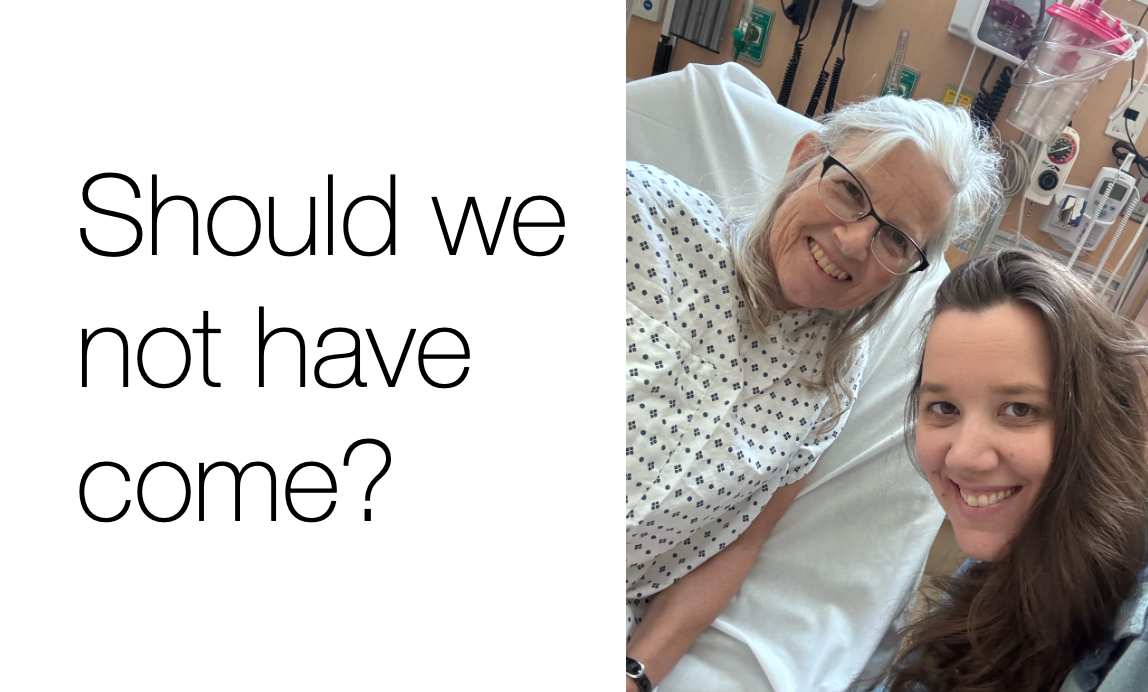
Should we not have come?

On a bright, sunny Thursday afternoon, I met my very first patient of attendinghood.
I had just finished emergency medicine residency a week before (yay!!), and was supposed to have a little more time off before my first attending shift. But that afternoon, she came early, walking straight into my home office…
It was my mom.
Kristen, do you have a second? I’m concerned. I’m having some chest pain. It’s like pressure on my chest. It’s going up my neck, and tingling down my arms…
[Me, internally: These are all the bad words.]
Ok, are you having any other symptoms?
Yes, I’m nauseous, and I feel really dizzy. [more bad words]
When did this start?
I’m feeling too dizzy to talk right now…
Mom, I’m taking you to the ER. Now.
These are the symptoms of a possible heart attack.
As we made our way to the ER, her symptoms thankfully started to improve. She felt well enough to talk again, and we reviewed her history… she’s had episodes like this before, but not frequently. The first time was four years ago and resulted in a stress test of her heart that was “probably normal,” per the report. But, these episodes didn’t occur when she was exercising — a good sign. And my mom is in extremely good shape and doesn’t have many risk factors for heart disease — another good sign.
By the time we finished talking, heart attack was thankfully not at the top of my list as the most likely cause.
Should we still go?
Yes, we need to rule it out.
We arrived at the ER where I trained and now work, and I took my first trip through the patient entrance. Aside from an accidental needle stick, I had never been a patient (or visitor) in my own ER. I learned this sort of gives you celebrity status. Why are you wearing normal clothes? Who is this with you? Your MOM??? Oh, we got you.
We made it through triage and back to a bed, and her test results started coming back: her EKG looked good — no signs of a heart attack. Her chest pain was gone, also a good sign. Sitting in a hospital gown after her blood was drawn, she looked at me and asked a question I’ve heard from patients over and over again:
If everything ends up being normal, was it a mistake that we came?
Was it a mistake that I came?
I hear this question from patients often, and it seems like most often from women. Sometimes they are even apologizing for coming to the ER once they hear their test results are normal. Perhaps it’s because women’s symptoms are often dismissed, and we don’t want to be seen as anxious or overreacting. And for every woman sitting in the ER wondering if she made a mistake coming in, there are many more at home who decided “not to bother anyone” and never came at all.
Ironically, the day before this happened I had come across this video from Elizabeth Banks raising awareness about the signs of a heart attack in women. As she suffers through the symptoms while making her kids’ lunches, finally lying down on the floor, she downplays her symptoms the whole time, saying “I’m fine” over and over again. When she finally calls 911, she starts with “sorry to bother you…”
Women are more likely to delay seeking care for a heart attack
Not everyone has an ER doctor daughter in the other room to ask about their symptoms, and many women choose to do what my mom probably would have done if I hadn’t been there: stay home. This has been extensively studied:
- Women are more likely to delay seeking care for symptoms of a heart attack, waiting at home instead of going to the hospital. (This means women are statistically more likely to UNDERREACT to their symptoms.)
- Women are more likely to misattribute symptoms of a heart attack, thinking symptoms are caused by something else
- And even when women do seek care for symptoms of a heart attack, they are more likely to have delays in care (delayed EKG, transport time by ambulance, etc.)
The result? A woman who has a heart attack is more likely to die from it within 30 days compared to a man. This is one of the reasons heart disease is the number one killer of women in the US, causing more deaths than all forms of cancer combined.
Yes, heart attacks do cause chest pain in women
There has been a substantial effort to educate the public on how heart attacks may look different in women — but unfortunately, this well-intended effort has led to additional confusion, including the belief that chest pain is not a common symptom in women. That’s not true. Here are the facts:
- For both men and women, chest pain is the most common symptom of a heart attack. It may feel like pain, pressure, or squeezing and can go to the arms, jaw, stomach, back, between the shoulder blades, or it may stay in the chest. Men experiencing heart attacks are slightly more likely to report chest pain compared to women (79% of men compared to 74% of women), but it is the most common symptom for both groups.
- Heart attacks can cause other symptoms including sweating, dizziness, palpitations, upset stomach, nausea, vomiting, trouble breathing, and unusual tiredness or weakness. Women are somewhat more likely than men to experience some of these symptoms (for example, one review found women with heart attacks were more likely to have nausea, vomiting, and shortness of breath compared to men), but any of these symptoms may be experienced by men or women.
Bottom line: while there are some differences in the frequency of heart attack symptoms experienced by men and women, all of these symptoms are concerning for a heart attack, for anyone.
Back in the ER, my mom’s troponins (a marker of heart damage) came back — normal. Her chest pain hadn’t returned, also a good sign. We spoke with her doctor (one of my favorite attendings who helped train me), and we decided on a course of action: even though her chest pain was gone and her test results were looking good, we couldn’t fully rule out heart disease. But, our ER has a chest pain center exactly for this situation, where patients can get a stress test or coronary CT angiography the next day, which are more definitive tests.
My mom experienced these episodes a few times before, and every time was left wondering what to do and whether they were a sign of a serious problem. And the “probably normal” stress test four years ago was now too old to rely on. This would give us an answer.
So she stayed overnight to get the test. The next day we got the results from the coronary CTA: my mom has the most beautiful coronary arteries you have ever seen. Zero blockage. Her heart is good.
Was it a mistake that we came?
No, even though her test results ended up being normal. Chest pain (especially in a 65-year-old woman like my mom), can be caused by all sorts of things. We can use clues to say when chest pain is more likely to be caused by a heart problem, but without testing (EKG, troponins, echocardiogram, stress test), we can’t say for sure.
In emergency medicine, our primary job is not to figure out the diagnosis — it’s to catch the emergencies. If there are ten women with chest pain like my mom, I want all ten to come in and get checked out, even if only one of them is actually having a heart attack. We can’t know which one it is until we do the testing.
And that testing won’t happen if they all stay at home, not wanting to bother anyone or be seen as overreacting. Nine of them will wake up the next morning with uncertainty. The tenth may not wake up.
If you have chest pain that concerns you (or other symptoms of a heart attack), do not hesitate to go to the ER. Even if your tests end up being normal, you did the right thing.
Kristen Panthagani, MD, PhD, is an emergency medicine physician completing a fellowship focusing on health communication. In her free time, she is the creator of the newsletters You Can Know Things and The Public Health Roundup. You can also find her on Instagram, Threads, and LinkedIn. Views expressed belong to KP, not her employer. The information provided here is for educational purposes only and is not a substitute for personalized medical advice. If you have questions or concerns about your health, talk with your healthcare provider.