RFK Jr.'s "big pharma" hypocrisy

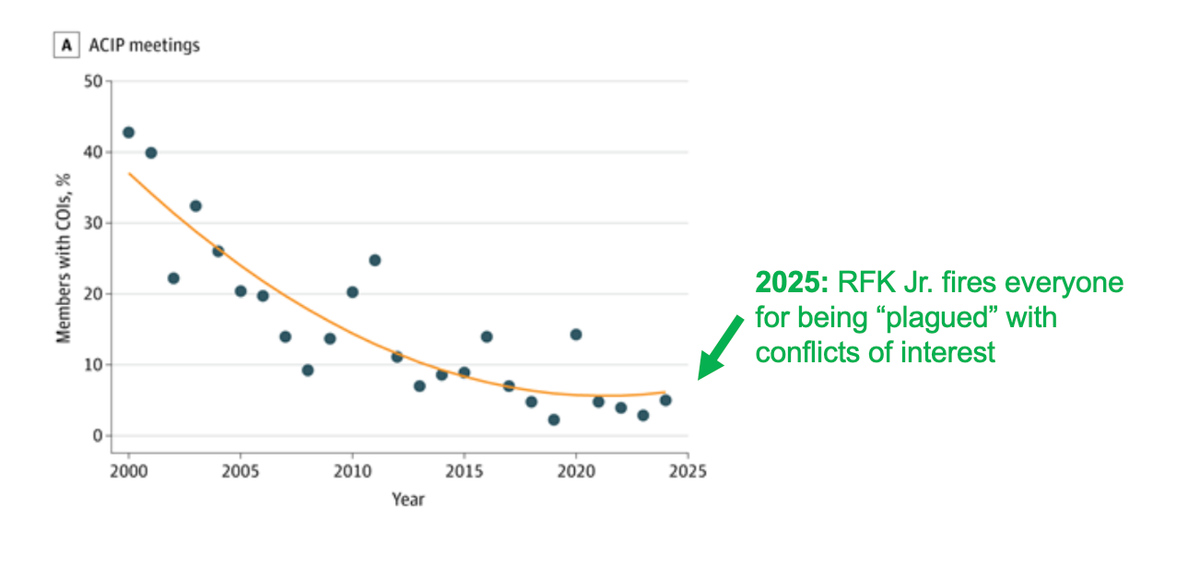
In June 2025, RFK Jr. wrote an op-ed in the Wall Street Journal announcing his decision to fire all 17 members of the CDC's vaccine advisory panel (ACIP).
His main criticism? “The committee has been plagued with persistent conflicts of interest and has become little more than a rubber stamp for any vaccine,” he falsely claimed.
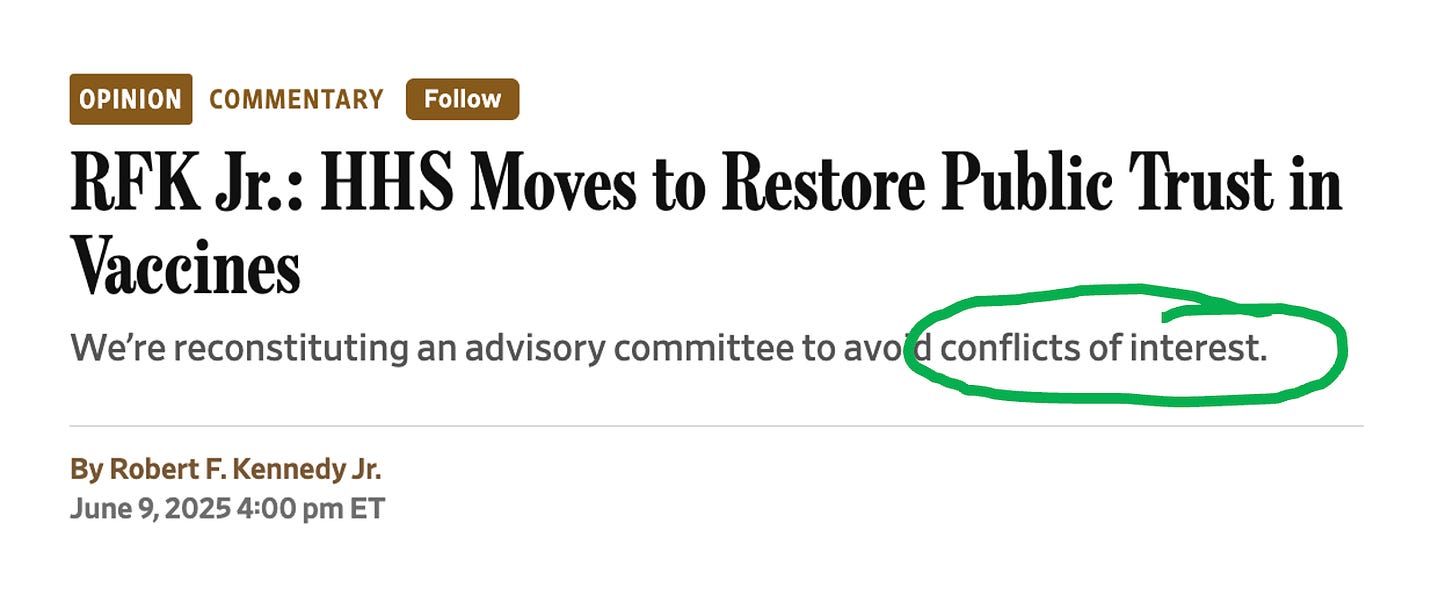
RFK Jr. has been making accusations like this for years. His book The Real Anthony Fauci devotes multiple chapters to the idea that pharmaceutical companies have corrupted and control government health agencies. In 2023, he said the “pharmaceutical industry owns the NIH, they’re all the owned subsidiaries of NIH, CDC, FDA”. In February 2025, just after becoming HHS secretary, RFK Jr. made accusations about federal advisory panels specifically:
“The panelists — in HHS, in FDA, CDC, and NIH, there are panels that are made up of outside individuals, outside experts, who come and set policies. They set, for example, […] the food pyramid, the nutrition guidelines, the vaccine guidelines, the medical standards of care. In the past those people, almost all of them, have severe, severe conflicts of interest.”
This was not true, especially not in 2024 just before RFK Jr. took office.
While there have certainly been instances in American history of conflicts of interest causing significant damage to federal regulatory oversight (see the opioid epidemic), the widespread corruption RFK Jr. alleged — that “almost all of them have severe, severe conflicts of interest,” was false. For example, an analysis of the vaccine advisory panel he fired found that before his tenure as HHS secretary, reported conflicts of interest of panel members declined steadily from the 2000 to 2024. And, the most common type of conflict of interest reported was not personal income — it was research support. After 2016, the analysis found less than 1% of members had conflicts of interest related to personal income (consulting, stock, royalties, etc.)
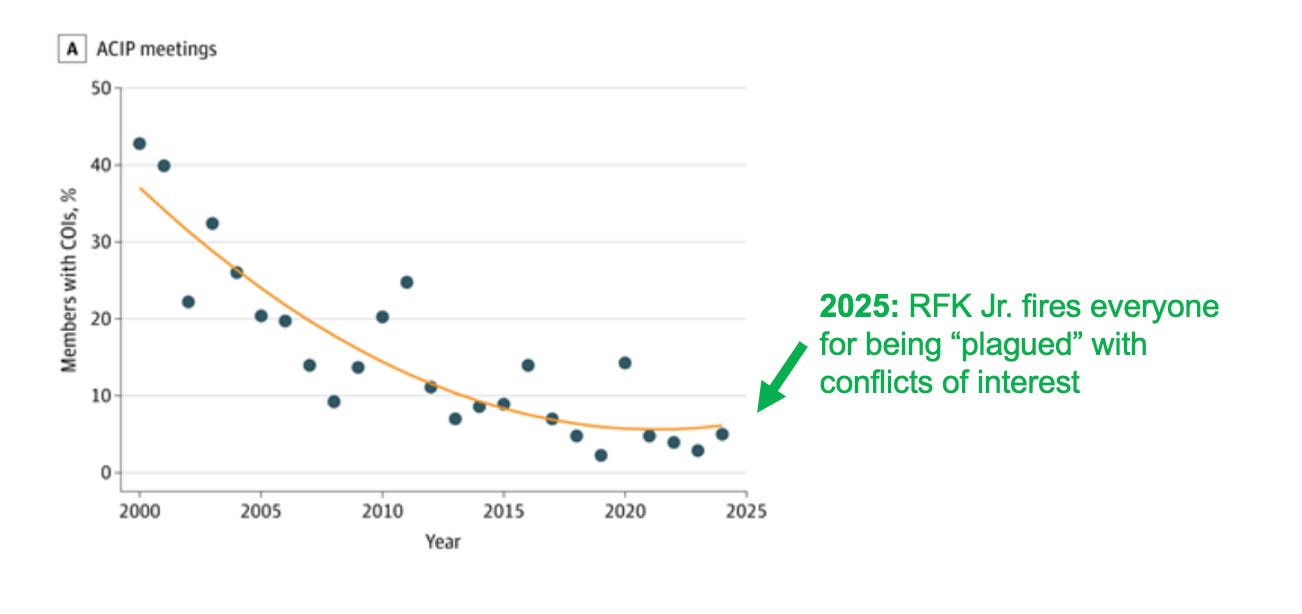
So after firing everyone, accusing them of being “plagued with persistent conflicts of interest,” what did he do? He appointed people with multiple financial conflicts of interest — across multiple federal panels.
Panel #1: CDC’s Vaccine Advisory Panel (ACIP)
A few days after firing everyone he announced his new nominees. They included an obstetrician whose LinkedIn profile listed him as current or former CMO, advisor, or board member of multiple pharmaceutical companies (this nominee later withdrew due to a review of his financial holdings.) RFK Jr. also appointed two members who had served as paid expert witnesses in a lawsuits against vaccine manufacturers, one of whom also previously served as CEO and CMO of different pharmaceutical companies and was involved in a whistleblower complaint over funding for a COVID trial early in the pandemic.
Panel #2: A FDA panel regulating peptides, full of peptide salesmen
A second example arrived in July 2026, when an FDA panel voted to loosen restrictions on six different peptides. In 2023 (pre-RFK Jr.), the FDA had banned compounding pharmacies from producing these peptides due to safety concerns.
Despite strong objections from FDA scientists, the new FDA panel voted to reverse that decision. That panel included new members appointed under RFK Jr.’s leadership — many of whom have direct ties to the peptide industry: a CMO of a wellness company that sells peptides, the founder of a company that provides “premier advisory in peptide therapy,” and the founder of a wellness company that provides custom protocols including peptide therapy, just to name a few (more are listed here.)
Under RFK Jr’s leadership, peptide salesman were given federal authority to loosen restrictions on peptide sales — and they did. This is utterly absurd.
Panel #3: Preventative health task force members own pharma stock
Last week brought us example #3 — after canceling a year’s worth of meetings of the US Preventive Services Task Force, RFK Jr. appointed eight new members to the group in September 2026. This task force makes national recommendations on preventive health care including cancer screenings, bone density scans, diabetes screenings, and much more. And its recommendations carry a lot of weight: they are adopted by doctor’s offices across the country and dictate insurance coverage.
A New York Times investigation found that four of the eight new members appointed by RFK Jr. own stock in pharmaceutical companies that will likely be influenced by their decisions on the task force. Stocks were described in conflict-of-interest waivers granted to these members, and include stock ownership in Eli Lilly, Johnson & Johnson, Merck, Pfizer, Cigna, CVS Health, and others. Before RFK Jr., candidates would have been asked to sell these stocks rather than being granted waivers. And if they refused, they would not have been granted a position on the task force.
The waivers contained an explanation of why these conflicts of interest were deemed acceptable — the rationale seemed to be that owning pharma stock was okay because 1. each member wasn’t making decisions unilaterally (they were only one of multiple members on the panel), and the stocks did not account for their entire portfolio.
This is also completely absurd.
After years of complaining about conflicts of interests in government health institutions, RFK Jr’s tenure as HHS secretary has brought just that: panels with members who have significant financial conflicts of interest. He claimed to want to restore trust in these institutions, but these appointments have done the opposite. It is so strange watching someone who has made this a centerpiece of his argument for decades reverse course as soon as he came to power. Perhaps he thought no one would notice, or that he would get away with it? So far, for the most part, he has.
Kristen Panthagani, MD, PhD, is an emergency medicine physician completing a research fellowship focusing on health literacy and communication. In her free time, she is the creator of the newsletters You Can Know Things and The Public Health Roundup. You can also find her on Instagram, Threads, and LinkedIn. Views expressed belong to KP, not her employer.